Helen Chadwick was a British conceptual artist who specialised in sculpture, photography and installation art. She was born in 1953 and studied at Brighton Polytechnic and the Chelsea School of Art. Chadwick was shortlisted for the Tuner Prize in 1987 and lectured at the Royal College of Art, Chelsea School of Art and the London Institute before dying of a viral infection in 1996 aged 42. Her incredible work has inspired a younger generation of artists to break usual conventions. She is notorious for her role in feminism and use of unusual organic materials such as meat, chocolate, bronze, flowers and rotting vegetable matter. Much of her work centres around desire and repulsion. Another focus of hers was the presentation of the female body and she often juxtaposed life and beauty with death and decay to create complex works which defied usual artistic boundaries.
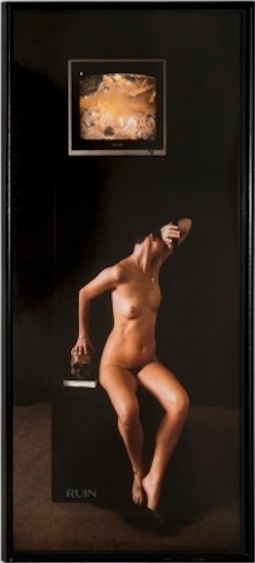
 An example of this is Ruin (left) a Cibachrome photograph on display at Richard Saulton in London as part of the exhibition "Helen Chadwick: Works From The Estate" which opened in May 2013 to mark what would have been her 60th birthday. It is 91.5 x 46 cm and was produced in 1986. This piece strips back the layers of life and presents in in all its stages: vitality, decay and death. It features Chadwick posing naked in the foreground with her hand resting on a skull and her head turned away, shielded by her left arm as if she cannot bear to face the impermanence of her beauty and life.
Her right arm is in a potentially suppressive motion; as if she is attempting to bury the skull and hide it to present only herself as the freshest layer of the life cycle. Conversely she could be supporting herself on it, representing than life builds upon death. It also illustrates how she is anchored to her fate whether she acknowledges it or not. As it is a photograph it has more impact than if it were painted as the strong reactions that the realism of a photograph produces contrast with how unconventional it's subject is.